Empowering Novel AgriBusiness-Led Employment (ENABLE) Youth Kenya
A joint flagship program of the Government of Kenya through the Ministry of Agriculture and Livestock Development (MoALD) and the African Development Bank Group (AfDB), designed to transition young educated Kenyan graduates into commercially viable, technology-driven agribusiness leaders.
Addressing youth unemployment while securing food and nutritional sovereignty across 47 counties.
Transforming Agriculture from Subsistence to Commercial Agribusiness
Agriculture remains the backbone of the Kenyan economy, contributing over 33% of GDP and employing 70% of the rural population. However, the sector faces an existential demographic challenge: the average age of a Kenyan farmer is 60 years, while youth unemployment stands at over 35%.
The ENABLE Youth Kenya Program was established to disrupt this narrative. By targeting educated youth (graduates holding Diplomas and Degrees) and immersing them in practical incubation, access to capital, and modern agro-technologies, the program converts educated job seekers into agripreneurial job creators.
Program Development Objectives
Four integrated pillars designed to overcome systemic barriers facing young agripreneurs in Kenya.
1. Mindset Transformation
Dismantle the perception that farming is a low-income subsistence chore. Rebrand agribusiness as a high-technology, lucrative, and prestigious enterprise for university and college graduates.
2. Incubation & Skills
Provide hands-on vocational, agronomic, business modeling, financial literacy, and ICT immersion through 8 specialized Youth Agribusiness Incubation Centres (YABICs).
3. Access to Soft Capital
Bridge the financial exclusion gap by providing risk-shared concessionary soft loans up to KES 2.0M via the Participating Financial Institutions (PFIs) without prohibitive traditional collateral.
4. Value Addition & Markets
Connect youth enterprises to lucrative commercial buyers, food processors, retail chains, and international export channels while embedding quality certification (KEBS) and post-harvest handling.
The Four Core Project Components
ENABLE Youth Kenya is structured into four mutually reinforcing components in accordance with the African Development Bank Project Appraisal Report.
Enabling Environment & Youth Agribusiness Ecosystem
Focuses on creating a conducive national policy, institutional, and social environment that champions youth participation in commercial agriculture across all 47 Kenyan counties.
Key Interventions & Deliverables:
- Mindset Change Campaigns: Nationwide advocacy, outreach, and media drives rebranding agribusiness among school leavers and graduates.
- Policy & Legal Harmonization: Supporting policies that ease youth access to agricultural land leases, tax relief on farm inputs, and streamlined business permits.
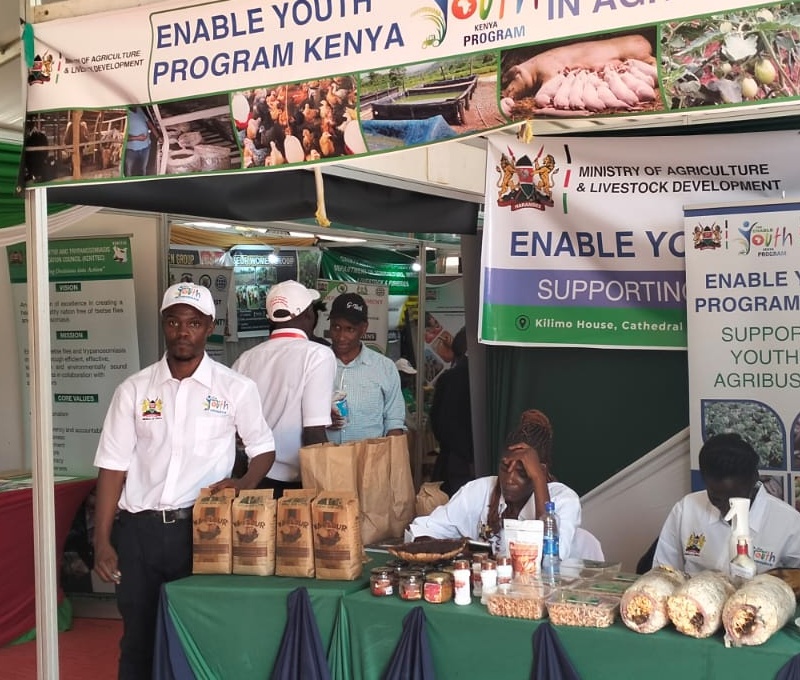
- Agribusiness Trade Fairs & Competitions: National and county-level exhibitions connecting youth innovators with investors and tech providers.
Agribusiness Incubation & Enterprise Development (8 YABICs)
The operational heart of the program. Establishes and equips 8 regional Youth Agribusiness Incubation Centres (YABICs) hosted at national research and tertiary training institutes.
Key Interventions & Deliverables:
- Two Incubation Tracks: Standard Track (intensive incubation for graduates launching new enterprises) and Accelerator Track (scaling established youth businesses).
- Hands-on Pilot Production Facilities: Equipped processing labs, greenhouses, cold rooms, and fish hatcheries at DTI Naivasha, Sagana, Kisii, Nyeri, Narok, Eldoret, RIAT, and Pwani.
- Business Plan Development: Rigorous coaching to formulate bankable, climate-smart agribusiness plans verified by investment panels.
Financing Commercial Youth Agri-Enterprises (PFIs Partnership)
Administers a dedicated youth agribusiness financing and risk-sharing window in partnership with the Participating Financial Institutions (PFIs) to solve youth credit constraints.
Key Interventions & Deliverables:
- Concessionary Soft Loans: Funding between KES 200,000 and KES 2,000,000 per approved youth enterprise with interest rates as low as 5% p.a.
- Biological Grace Periods: Moratorium on repayments aligned with biological harvest, milking, or fattening cycles (3 to 12 months).
- Collateral-Free / Chattel Financing: Equipment and enterprise assets purchased serve as primary security, removing prohibitive land title requirements.
Program Management, Coordination & M&E
Ensures rigorous governance, environmental and social safeguards compliance, gender mainstreaming, and real-time monitoring of enterprise survival rates and job creation.
Key Interventions & Deliverables:
- National Program Coordination Unit (NPCU): Housed at Kilimo House Nairobi, overseeing procurement, financial accountability, and AfDB reporting.
- Environmental & Social Management (ESMF): Strict adherence to climate-smart farming, clean water protection, and safe chemical management.
- Grievance Redress Mechanism (GRM): Transparent, toll-free stakeholder and incubatee complaint and dispute resolution channels.
The 5-Stage Incubatee Lifecycle
From transparent national recruitment to commercial enterprise launch and scaling.
Call & Merit Selection
National Gazette notice, online portal applications, and county desk vetting against age and educational eligibility criteria.
Residential Incubation
3 to 6 months hands-on practical immersion in agronomy, food processing, financial modeling, and specialized mentoring at host YABICs.
Business Plan Pitch
Formulation of bankable, climate-smart agribusiness proposals and pitching before independent technical & investment appraisal panels.
PFIs Loan Financing
Rapid PFIs loan appraisal, asset purchase (tractors, cooling tanks, feed mills), and disbursement with biological production grace periods.
Commercial Off-Taking
Direct buyer contracts with food processors, supermarket chains, export aggregators, and ongoing post-incubation BDS advisory.
Targeting Educated Youth with a Strict Gender Parity Mandate
Unlike conventional rural relief programs, ENABLE Youth Kenya explicitly targets youth with post-secondary education who possess the cognitive capacity to manage complex value chains, implement computerized accounting, adopt precision agriculture, and satisfy stringent sanitary and phytosanitary (SPS) export standards.
National Inclusivity Safeguards
Implementing & Financial Governance
Collaboration between government ministries, bilateral development institutions, and national academia.
Ministry of Agriculture & Livestock Dev.
Lead Executing AgencyHouses the National Program Coordination Unit (NPCU) at Kilimo House, providing overall strategic policy direction, county liaison, gazette recruitment, and national oversight.
African Development Bank (AfDB)
Co-Financier & Development PartnerFinances the ENABLE Youth Kenya Program under the continental Feed Africa strategy (Project ID: P-KE-AA0-022), providing fiduciary supervision and knowledge transfer across Africa.
Participating Financial Institutions (PFIs)
Financial IntermediaryState-owned agricultural development bank administering the Youth Agribusiness Credit Window, appraising business proposals, disbursing loans, and managing revolving credit recovery.
Host Academic & Research Institutions (8 YABICs)
Specialized practical training hubs embedded in Kenya's top universities and national vocational institutes.
Frequently Asked Questions
Official answers regarding program eligibility, financial support, and application processes.
Ready to Explore More About ENABLE Youth Kenya?
Access official guidelines, Kenya Gazette notices, and the full directory of all 8 Youth Agribusiness Incubation Centres.